Las ventanas: el eslabón débil de la envolvente
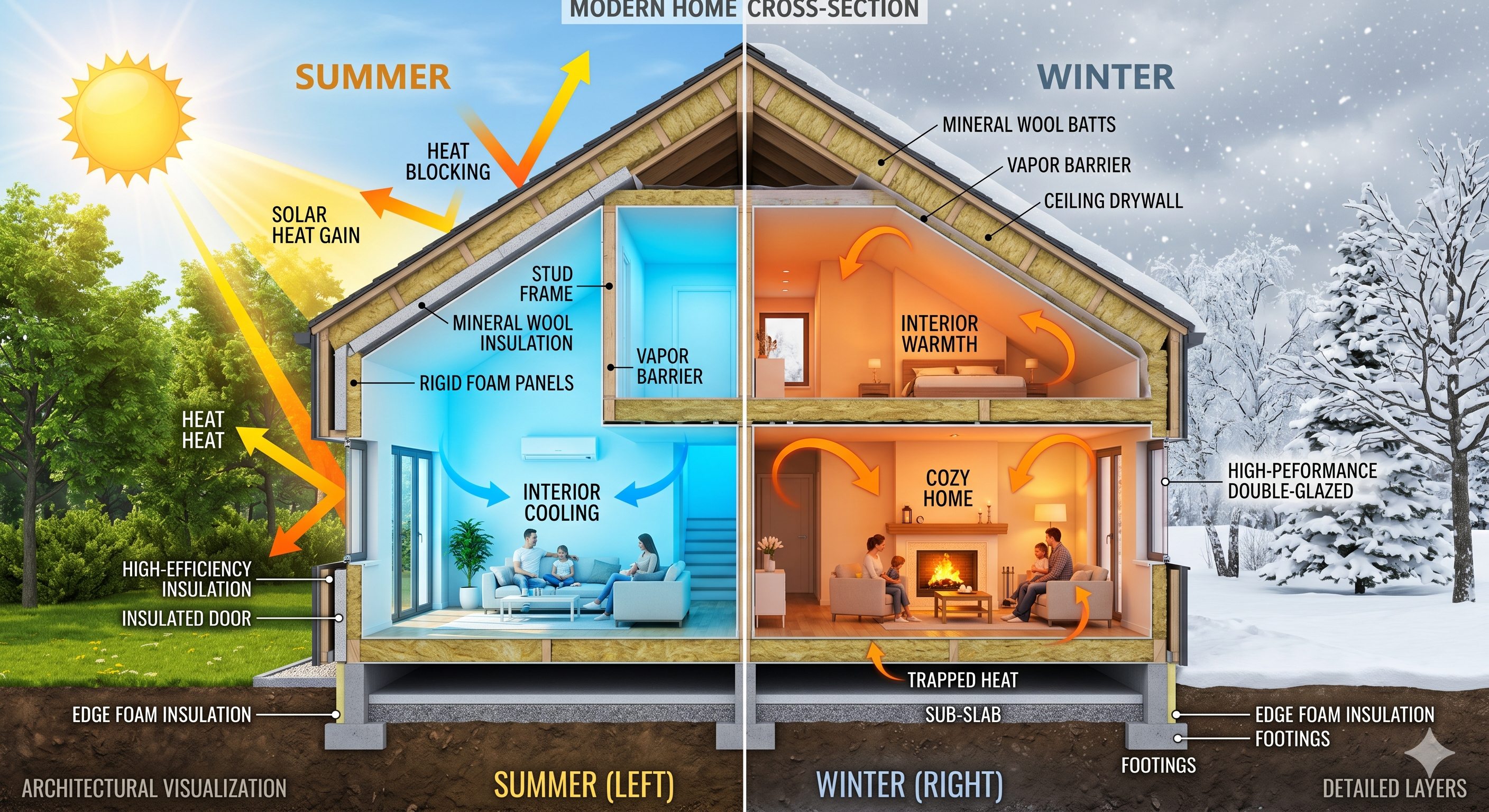
Las ventanas y puertas vidriadas son el componente de mayor fuga térmica en una construcción convencional. Mientras una pared de ladrillo bien construida tiene un coeficiente de transmitancia U de 1,5–2,0 W/m²K, un vidrio simple de 4 mm tiene U = 5,90 W/m²K: pierde calor unas tres veces más rápido. En verano, ese mismo vidrio deja pasar la radiación solar y convierte los ambientes en invernaderos. Y en entornos urbanos ruidosos, es la superficie que menos frena el sonido.
Sin embargo, elegir mal las ventanas es el error más difundido en la construcción residencial de Argentina y Chile. El motivo es simple: la diferencia visual entre un DVH y un vidrio simple es nula, pero la diferencia de performance es enorme. Muchos propietarios invierten en un vidrio de calidad y luego lo instalan en un marco de aluminio sin rotura de puente térmico, anulando gran parte del beneficio.
Esta guía descompone el sistema ventana en sus partes —vidrio, cámara, gas, marco y sellado— y explica cómo cada decisión impacta en el resultado final. Con esta información podés llegar a cualquier carpintería o vidriería y hacer las preguntas correctas.
52%
reducción de transmitancia del DVH 4/9/4 vs vidrio simple (2,82 vs 5,90 W/m²K)
30%
ahorro anual en calefacción y refrigeración al pasar de vidrio simple a DVH
50 dB
atenuación acústica máxima de un DVH correctamente configurado
20%
de la pérdida energética total de un edificio ocurre por las aberturas
DVH: Composición, Tipos y Configuraciones
El Doble Vidriado Hermético (DVH) —llamado termopanel en Chile— es un sistema compuesto por dos hojas de vidrio separadas por una cámara sellada herméticamente. La hermeticidad es crítica: si la cámara no está bien sellada, entra humedad y el sistema se deteriora de forma irreversible.
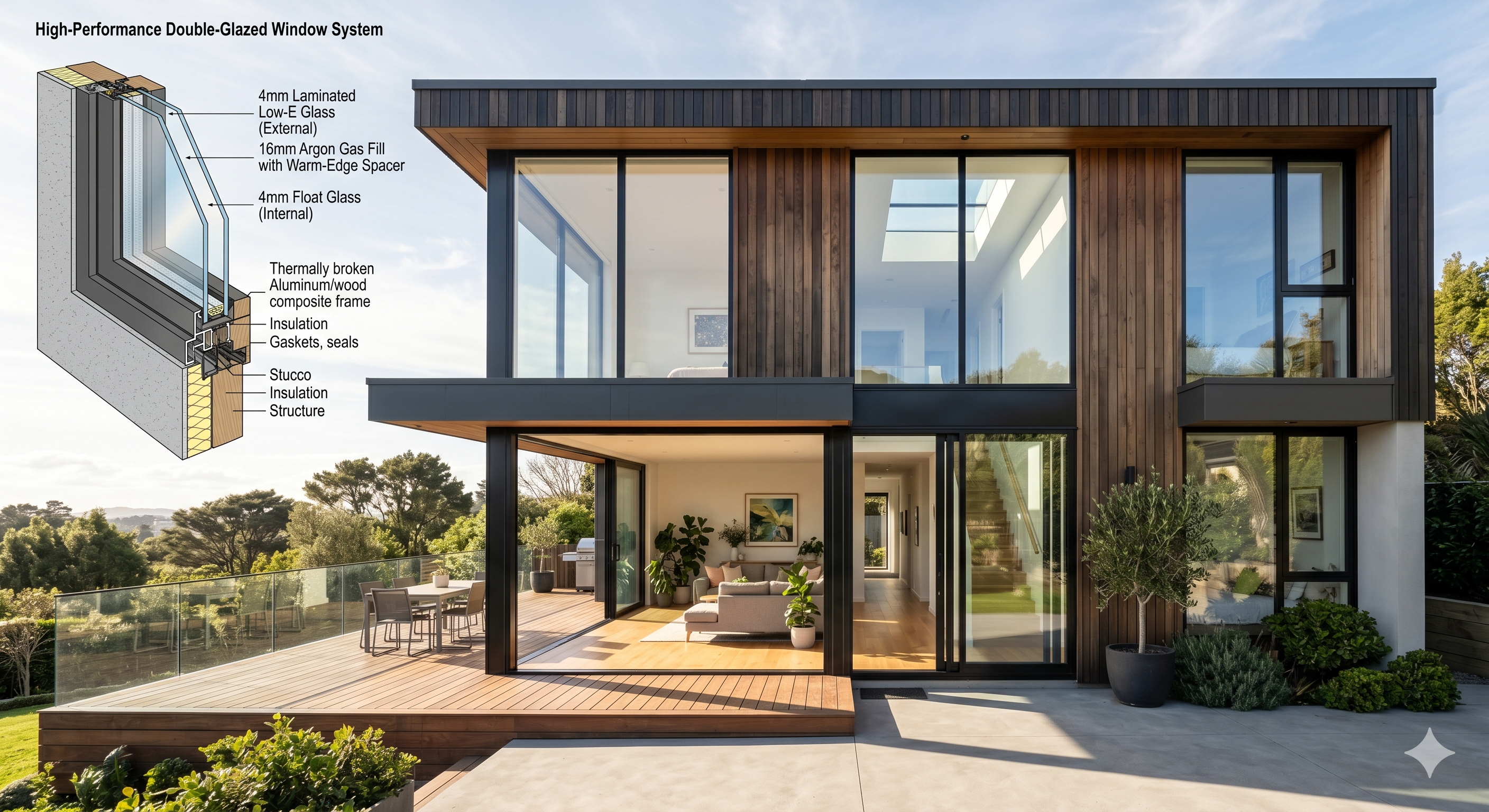
Anatomía de un DVH
Un DVH correctamente fabricado tiene cuatro componentes principales:
-
Las dos hojas de vidrio
Pueden ser vidrio flotado estándar, vidrio templado, vidrio laminado o vidrio Low-E. La elección del tipo determina las propiedades finales del conjunto. El espesor más común en residencial es 4 mm, aunque pueden usarse 3, 5 o 6 mm según el requerimiento.
-
El marco separador (spacer)
El perfil de aluminio (o de material compuesto en los modelos "warm edge") que mantiene los vidrios a la distancia correcta. En su interior hay tamiz molecular (zeolita), un material desecante que absorbe el vapor de agua residual que queda en la cámara durante el proceso de fabricación. Este es el componente crítico de la durabilidad del DVH.
-
El sello primario de butilo
Una capa de butilo aplicado en caliente (hot-melt) que adhiere el espaciador a las hojas de vidrio y es la primera barrera contra la penetración de humedad. Su correcta aplicación y espesor determinan en gran medida la vida útil del DVH.
-
El sello secundario de silicona o polisulfuro
Aplicado en el perímetro exterior del conjunto para dar resistencia estructural y una segunda barrera de estanqueidad. En DVH de alta performance se usa polisulfuro en lugar de silicona por su mayor resistencia a la difusión de gases.
Configuraciones estándar y su aplicación
| Configuración |
Valor U vidrio (W/m²K) |
Uso recomendado |
Observaciones |
| Vidrio simple 4 mm |
5,90 |
No recomendado |
Referencia comparativa |
| DVH 3/9/3 |
~3,1 |
Residencial básico |
Económico, bajo peso |
| DVH 4/9/4 |
2,82 |
Residencial estándar |
Configuración más difundida en Argentina |
| DVH 4/12/4 |
~2,6 |
Residencial mejorado |
Mayor cámara, mejor performance |
| DVH 4/12/4 argón |
~2,3 |
Alta performance |
+~3 dB acústico extra |
| DVH Low-E 4/12/4 |
~1,4 |
Eficiencia premium |
Mejor relación costo-beneficio térmico |
| DVH Low-E 4/12/4 argón |
~1,0–1,2 |
Máxima eficiencia |
Zonas frías extremas (Patagonia, sur de Chile) |
| DVH 4/9/3+3 laminado |
~2,8 |
Seguridad + térmico |
Ideal para frentes y plantas bajas |
Normas argentinas de fabricación
Los DVH fabricados en Argentina deben cumplir IRAM 12598-1 (requisitos generales), IRAM 12598-2 (ensayo de penetración de humedad en la cámara) e IRAM 12597 (buenas prácticas de fabricación). Exigí certificación de fábrica antes de comprar: dos DVH visualmente idénticos pueden diferir en un 50% en su valor U real si uno usa sellados de menor calidad.
Gas argón: cuándo vale la pena
El gas argón es un gas noble inodoro, atóxico e inocuo que se usa para rellenar la cámara del DVH en lugar de aire seco. Su menor conductividad térmica frente al aire mejora el valor U en aproximadamente 0,3 W/m²K respecto a una cámara de aire idéntica, y aporta unos 3 dB adicionales de atenuación acústica. En condiciones de instalación correcta, el argón pierde alrededor del 10% de su carga cada 20 años: una vida útil comparable a la de la ventana.
El sobrecoste del argón sobre un DVH estándar es de entre un 10% y un 20%. Si el presupuesto es limitado, la prioridad de inversión para clima frío debería ser: primero aumentar el espesor de la cámara (de 9 a 12 mm), luego incorporar Low-E y, como tercer paso, agregar argón.
Vidrio Laminado PVB: Seguridad, Acústica y Protección UV
El vidrio laminado se fabrica uniendo dos o más hojas de vidrio mediante una o más láminas de butiral de polivinilo (PVB). La lámina de PVB tiene un espesor mínimo de 0,76 mm y es lo que confiere al vidrio laminado su característica principal: ante un impacto, el vidrio se rompe pero los fragmentos permanecen adheridos a la lámina, sin proyectarse al espacio.
Configuraciones más comunes y valor U
El laminado 3+3 (dos hojas de 3 mm unidas por PVB) tiene un valor U de aproximadamente 4,02 W/m²K: mejor que el vidrio simple pero significativamente peor que cualquier DVH. Esto confirma que el vidrio laminado solo no es una solución de aislación térmica, sino de seguridad.
La combinación óptima: DVH + laminado
Para obtener las tres propiedades simultáneamente (aislación térmica, reducción acústica y seguridad ante rotura), la solución es fabricar un DVH donde uno o ambos vidrios sean laminados. Por ejemplo: 3+3 / 12 / 4 o 4 / 12 / 3+3. Estas configuraciones son ideales para balcones, fachadas expuestas a viento y cualquier abertura en planta baja o en zonas de tránsito.
Ventajas específicas del PVB
- Seguridad ante impacto: los fragmentos quedan adheridos a la lámina, evitando heridas por trozos volantes. Obligatorio en techos vidriados, barandas y escaleras (NCh2545 en Chile).
- Filtrado UV: el PVB filtra hasta el 99% de la radiación ultravioleta, protegiendo muebles, pisos y textiles de la decoloración solar.
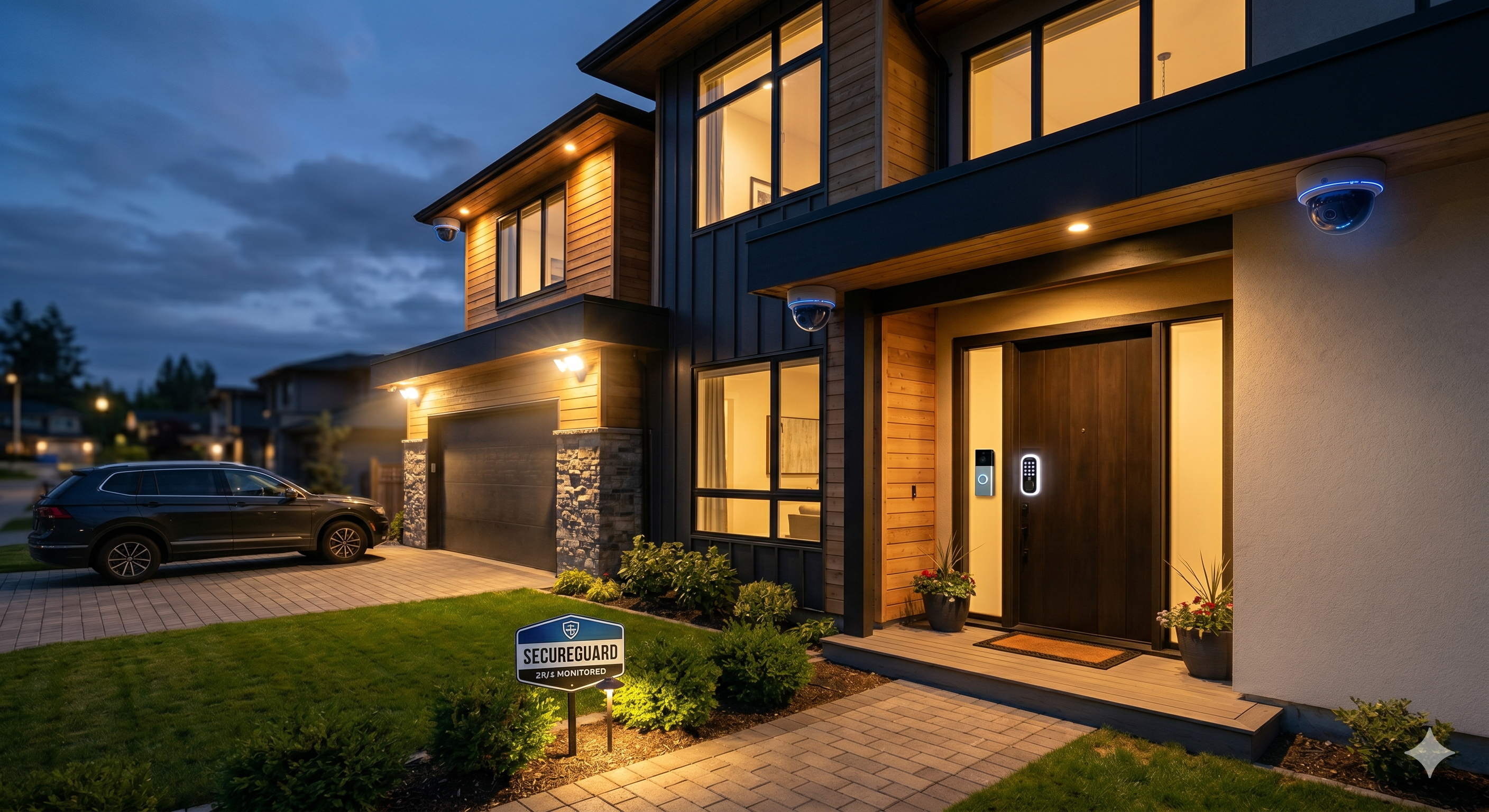
- Resistencia a la efracción: aunque el vidrio se rompa ante un intento de robo, la lámina PVB resiste la penetración y da tiempo para activar alarmas.
- Mejora acústica: el laminado reduce el ruido más que un vidrio simple de igual espesor total, aunque la diferencia es menor que la que aporta un DVH.
El laminado simple (sin DVH) se usa principalmente en techos vidriados, barandas, frentes comerciales a nivel de calle y vidrios de vehículos, donde la seguridad o la protección UV es el objetivo primario y no se requiere aislación térmica.
Marcos: PVC vs Aluminio con RPT
El marco es la parte de la ventana que más se subestima. Un DVH excelente instalado en un marco de aluminio sin rotura de puente térmico pierde entre el 30% y el 50% de su beneficio térmico: el aluminio conduce el calor directamente del exterior al interior, creando una franja fría continua en el perímetro de la ventana.
Marcos de PVC
El PVC es el material con mejor relación costo-beneficio térmico para uso residencial. Su conductividad térmica es de 0,17 W/mK, comparable a la de la madera y unas 1.000 veces menor que la del aluminio. No requiere ninguna intervención adicional para funcionar como aislante: la geometría de las celdas internas del perfil incorpora cámaras de aire que potencian el aislamiento.
Marcos de aluminio estándar (sin RPT)
El aluminio tiene una conductividad térmica de 160–200 W/mK: es el material más conductor de los usados en carpintería. Sin rotura de puente térmico, el perfil transmite el frío/calor del exterior directamente al interior, generando condensación en el marco y anulando gran parte de la inversión en el DVH. Aluminio estándar + DVH es el error más documentado en la construcción argentina.
Marcos de aluminio con Rotura de Puente Térmico (RPT)
La RPT es la inserción de un perfil de poliamida reforzada con fibra de vidrio que interrumpe físicamente la continuidad metálica entre la cara interior y exterior del perfil. A mayor espesor del perfil de poliamida, mayor aislación térmica del marco. Con RPT, el aluminio alcanza prestaciones térmicas comparables al PVC, manteniendo la resistencia mecánica y la estética del aluminio.
| Característica |
PVC |
Aluminio estándar |
Aluminio RPT |
| Conductividad térmica |
0,17 W/mK (excelente) |
160–200 W/mK (muy alta) |
Similar al PVC con RPT de espesor adecuado |
| Aislación acústica del marco |
Superior por naturaleza |
Inferior, transmite vibración |
Intermedio, mejora con RPT grueso |
| Resistencia mecánica |
Buena, puede requerir refuerzos en vanos grandes |
Excelente, permite vanos de gran luz |
Excelente, mantiene la resistencia del aluminio |
| Mantenimiento |
Mínimo: agua y jabón, no se oxida |
Anodizado o pintado, puede oxidarse en costa |
Anodizado o pintado, similar al estándar |
| Durabilidad estimada |
30–50 años |
30–40 años |
30–40 años |
| Costo relativo (mismo DVH) |
Bajo-medio |
Bajo |
Alto |
| Recomendación |
Uso residencial general |
No combinar con DVH sin RPT |
Proyectos premium, climas fríos extremos |
Error crítico a evitar
Instalar un DVH de calidad en un marco de aluminio sin rotura de puente térmico es un error que anula gran parte de la inversión. El puente térmico del marco puede representar entre el 15% y el 25% de la pérdida total de calor de la ventana. Si ya tenés carpintería de aluminio estándar y querés mejorar la eficiencia, la única solución real es reemplazar los perfiles RPT, no solo el vidrio.
Valor U, Factor Solar y Zonas Climáticas
El coeficiente U (también llamado K en la nomenclatura más antigua) mide los watts de calor que atraviesan 1 m² de cerramiento por cada grado Celsius de diferencia entre interior y exterior. A menor valor U, mejor aislación. Para ventanas, el valor U final del sistema contempla tanto el vidrio (Ug) como el marco (Uf) en una sola cifra integrada (Uw).
Tabla de valores U comparativos
| Composición del vidrio |
Valor U vidrio (W/m²K) |
Reducción vs simple |
| Vidrio simple 4 mm |
5,90 |
Referencia (0%) |
| Laminado 3+3 mm |
4,02 |
−32% |
| DVH 4/6/4 (cámara 6 mm) |
~3,3 |
−44% |
| DVH 4/9/4 (cámara 9 mm) |
2,82 |
−52% |
| DVH 4/12/4 (cámara 12 mm) |
~2,6 |
−56% |
| DVH 4/12/4 con argón |
~2,3 |
−61% |
| DVH Low-E 4/12/4 |
~1,4 |
−76% |
| DVH Low-E 4/12/4 con argón |
~1,0–1,2 |
−83% |
Zonas climáticas y recomendaciones por región
La norma argentina IRAM 11507-6:2018 establece el método de cálculo oficial para el etiquetado energético de ventanas (clasificación de A a G), considerando transmitancia de vidrios y perfiles, factor solar y filtraciones de aire en 5 zonas climáticas. La herramienta online oficial está en etiquetadoventanas.energia.gob.ar.
- Zona I (Norte, NEA, NOA): Clima muy cálido. Prioridad: control solar (vidrios con coating reflectivo, valor g < 0,4). El DVH mejora la eficiencia del aire acondicionado.
- Zona II (Buenos Aires, Córdoba litoral): Clima templado-cálido. DVH 4/9/4 como mínimo. Con marco de PVC o aluminio RPT, se logra etiqueta B-C del sistema IRAM.
- Zona III (Mendoza, San Luis, centro): Clima templado. DVH 4/12/4 recomendado. Argón o Low-E justificados por el invierno seco.
- Zona IV (Patagonia norte, precordillera): Clima frío. DVH Low-E o con argón recomendado. Marcos con RPT obligatorios para no generar condensación.
- Zona V (Patagonia sur, Tierra del Fuego): Clima muy frío. DVH Low-E 4/12/4 con argón como mínimo. Evaluar triple vidriado (TVH) en proyectos de alta demanda.
En Chile, la Reglamentación Térmica del MINVU (RT, con actualizaciones hacia RT-2025) exige valores U máximos progresivamente más estrictos según zona térmica (1 a 7, de norte a sur). En las zonas 6 y 7 (Aysén, Magallanes), el DVH con argón o Low-E puede ser requerimiento mínimo en proyectos nuevos. La norma NCh2545 regula el uso de vidrio laminado en zonas de alto tránsito o riesgo de impacto.
Factor solar (g): el otro coeficiente clave
El factor solar g (o FS) mide qué porción de la radiación solar incidente sobre el vidrio termina ingresando al espacio interior en forma de calor. Un valor g = 0,7 significa que el 70% de la radiación solar se convierte en calor interior. En zonas cálidas, un valor g bajo (< 0,4) puede ser más importante que el valor U para reducir el consumo de aire acondicionado. Los vidrios con coating de control solar combinan un bajo factor solar con alta transmisión de luz visible.
Consejo para zonas cálidas
En el norte argentino, Mendoza en verano y las zonas 1–3 de Chile, un vidrio tintado o con coating reflectivo (valor g < 0,4) puede reducir más el consumo de climatización que pasar de un DVH 4/9/4 a uno Low-E. Consultá siempre el factor solar del vidrio además del valor U antes de comprar.
Mitos y Errores Frecuentes
El mercado de vidrios está rodeado de afirmaciones imprecisas que llevan a malas decisiones de compra. Estos son los mitos más frecuentes en Argentina y Chile:
Mito 1: "Todo DVH es igual"
Dos DVH visualmente idénticos pueden tener valores U que difieren en un 50% según el espesor de la cámara, el tipo de gas, si los vidrios son estándar o Low-E, y la calidad del sellado. Siempre pedí la ficha técnica con el valor U certificado del fabricante.
Mito 2: "El DVH elimina totalmente el ruido"
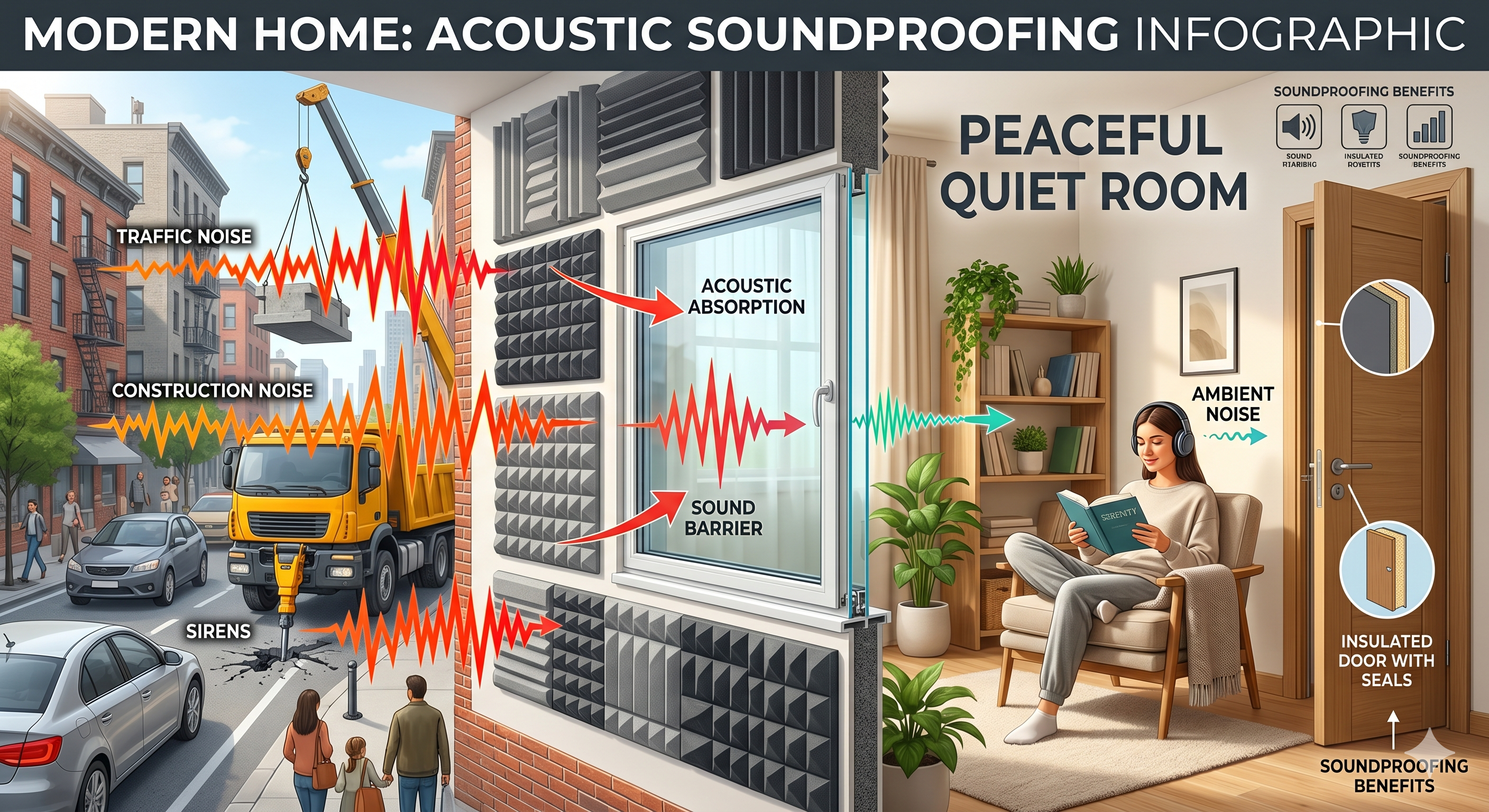
El DVH 4/9/4 estándar reduce el ruido entre 30 y 35 dB en condiciones óptimas. Para superar los 40 dB se necesitan cámaras más grandes, composición asimétrica de los vidrios (espesores diferentes en cada hoja, ej: 6/12/4) o vidrios laminados acústicos en la composición. Las ventanas con DVH estándar no fueron diseñadas para aislación acústica de alta demanda urbana.
Mito 3: "El DVH no genera condensación"
El DVH elimina la condensación sobre la cara interior del vidrio (el problema del vidrio simple). Pero si el marco no tiene RPT, la condensación se desplaza al perfil del marco. Si aparece vapor entre los dos vidrios (en la cámara), indica falla del sellado: es un defecto que requiere reemplazo del DVH.
Mito 4: "El DVH solo sirve para el frío"
El DVH actúa como barrera bidireccional: en invierno retiene el calor interior, y en verano impide la entrada del calor exterior. En zonas cálidas, combinado con vidrios de control solar, potencia el beneficio en modo refrigeración reduciendo la demanda del aire acondicionado.
Mito 5: "Con poner DVH ya tengo una ventana eficiente"
La ventana es un sistema integral. Un DVH excelente mal instalado, con puentes térmicos en el marco o sellos de silicona de baja calidad (que se degradan en 3–5 años), pierde buena parte de su performance. El error más documentado es usar silicona barata para sellar el perímetro entre el marco y la pared.
Costos Orientativos: Argentina y Chile
Los precios a continuación son referenciales (mayo 2025) y se expresan en dólares estadounidenses. En Argentina, los precios en pesos varían con el tipo de cambio; en Chile son en CLP con tipo de cambio ~950 CLP/USD.
Argentina
| Producto |
Dimensión |
Precio orientativo (USD) |
| Solo vidrio DVH 4/9/4 (por m²) |
por m² |
USD 35–70 |
| Ventana PVC + DVH 4/9/4 (corrediza) |
1,00 × 0,90 m |
USD 200–280 |
| Ventana PVC + DVH (balcón) |
1,50 × 2,00 m |
USD 900–1.200 |
| Ventana aluminio estándar + DVH |
1,20 × 1,10 m |
USD 150–250 |
| Ventana aluminio RPT + DVH |
1,20 × 1,10 m |
USD 350–600 |
| Sobreprecio DVH Low-E o con argón |
— |
+20% a +40% sobre DVH estándar |
Chile
| Producto |
Precio (CLP/m²) |
Equivalente (USD/m²) |
| Ventana PVC + termopanel (DVH) |
CLP 85.000–250.000 |
USD 90–265 |
| Ventana aluminio + termopanel |
CLP 110.000–190.000 |
USD 116–200 |
| Ventana aluminio RPT + termopanel |
CLP 150.000–280.000 |
USD 158–295 |
| Instalación (adicional) |
+20% a +30% sobre precio ventana |
— |
Espaciadores "warm edge": un detalle que suma
El espaciador metálico de aluminio entre los vidrios es en sí mismo un micro-puente térmico en el perímetro del DVH. Los espaciadores de borde caliente (warm edge), fabricados en plástico o materiales compuestos en lugar de aluminio, mejoran el valor U total de la ventana entre un 5% y un 10% adicional. En instalaciones de alta performance, son un complemento recomendable a bajo costo incremental.
Planificá tus ventanas con ArqPlano
La elección del vidrio y el marco correcto empieza por saber exactamente cuántas aberturas tenés, de qué tamaño son y cuál es su orientación (norte, sur, este, oeste). Una ventana orientada al norte capta sol todo el año; una al sur recibe radiación difusa fría. Esta información cambia radicalmente la recomendación de vidrio: factor solar bajo para orientaciones norte/este, mayor captación solar pasiva para sur/suroeste en zonas frías.
Con ArqPlano podés dibujar el plano de tu vivienda con todas las aberturas correctamente ubicadas, definir sus dimensiones y obtener el inventario completo de ventanas y puertas vidriadas para presupuestar con precisión. Así llegás al carpintero o a la vidriería con los datos exactos y la orientación correcta de cada abertura.
Windows: The Weak Link in the Building Envelope
Windows and glazed doors are the component with the highest thermal leakage in conventional construction. While a properly built brick wall has a thermal transmittance U of 1.5–2.0 W/m²K, a 4 mm single pane of glass has U = 5.90 W/m²K — it loses heat about three times faster. In summer, that same glass allows solar radiation to pass through and turns rooms into greenhouses. And in noisy urban environments, it is the surface that offers the least resistance to sound.
Yet choosing the wrong windows is the most widespread error in residential construction in Argentina and Chile. The reason is simple: the visual difference between a DVH (double-glazed unit) and a single pane is zero, but the performance difference is enormous. Many homeowners invest in quality glazing and then install it in an aluminum frame without a thermal break, nullifying much of the benefit.
This guide breaks down the window system into its parts — glass, cavity, gas, frame, and sealing — and explains how each decision impacts the final result. With this information you can walk into any carpentry shop or glass supplier and ask the right questions.
52%
reduction in transmittance of DVH 4/9/4 vs single glass (2.82 vs 5.90 W/m²K)
30%
annual savings in heating and cooling when switching from single glass to DVH
50 dB
maximum acoustic attenuation of a properly configured double-glazed unit
20%
of a building's total energy loss occurs through windows and doors
DVH Double Glazing: Composition, Types, and Configurations
The Doble Vidriado Hermético (DVH) — known as termopanel in Chile and as an insulating glass unit (IGU) internationally — is a system composed of two glass panes separated by a hermetically sealed cavity. The airtightness is critical: if the cavity is not properly sealed, moisture enters and the system deteriorates irreversibly.
Anatomy of a DVH
A properly manufactured DVH has four main components:
-
The two glass panes
These can be standard float glass, tempered glass, laminated glass, or Low-E glass. The choice of type determines the final properties of the assembly. The most common thickness in residential applications is 4 mm, although 3, 5, or 6 mm can be used depending on the requirement.
-
The spacer bar
The aluminum profile (or composite material in "warm edge" models) that keeps the panes at the correct distance. Inside the spacer is molecular sieve (zeolite), a desiccant material that absorbs residual water vapor left in the cavity during manufacturing. This is the critical component for DVH durability.
-
The primary butyl seal
A layer of hot-melt butyl applied to bond the spacer to the glass panes, serving as the first barrier against moisture penetration. Its proper application and thickness largely determine the service life of the DVH.
-
The secondary silicone or polysulfide seal
Applied around the exterior perimeter of the assembly to provide structural strength and a second airtight barrier. In high-performance DVH units, polysulfide is used instead of silicone for its greater resistance to gas diffusion.
Standard configurations and their applications
| Configuration |
Glass U-value (W/m²K) |
Recommended use |
Notes |
| Single glass 4 mm |
5.90 |
Not recommended |
Comparative reference |
| DVH 3/9/3 |
~3.1 |
Basic residential |
Economical, low weight |
| DVH 4/9/4 |
2.82 |
Standard residential |
Most widespread configuration in Argentina |
| DVH 4/12/4 |
~2.6 |
Enhanced residential |
Larger cavity, better performance |
| DVH 4/12/4 argon |
~2.3 |
High performance |
~3 dB extra acoustic benefit |
| DVH Low-E 4/12/4 |
~1.4 |
Premium thermal efficiency |
Best thermal cost-benefit ratio |
| DVH Low-E 4/12/4 argon |
~1.0–1.2 |
Maximum efficiency |
Extreme cold zones (Patagonia, southern Chile) |
| DVH 4/9/3+3 laminated |
~2.8 |
Safety + thermal |
Ideal for facades and ground-floor openings |
Argentine manufacturing standards
DVH units manufactured in Argentina must comply with IRAM 12598-1 (general requirements), IRAM 12598-2 (moisture penetration test in the cavity), and IRAM 12597 (good manufacturing practices). Always ask for factory certification before buying: two visually identical DVH units can differ by 50% in their actual U-value if one uses lower-quality seals.
Argon gas: when it's worth it
Argon is an odorless, non-toxic, and inert noble gas used to fill the DVH cavity instead of dry air. Its lower thermal conductivity improves the U-value by approximately 0.3 W/m²K compared to an identical air cavity, and provides around 3 additional dB of acoustic attenuation. Under correct installation conditions, argon loses approximately 10% of its charge every 20 years — a service life comparable to that of the window itself.
The additional cost of argon over a standard DVH is between 10% and 20%. If the budget is limited, the investment priority for cold climates should be: first increase the cavity thickness (from 9 to 12 mm), then incorporate Low-E glass, and as a third step add argon.
Laminated PVB Glass: Safety, Acoustics, and UV Protection
Laminated glass is manufactured by bonding two or more glass panes together using one or more layers of polyvinyl butyral (PVB). The PVB interlayer has a minimum thickness of 0.76 mm, and it is what gives laminated glass its main characteristic: when struck, the glass breaks but the fragments remain adhered to the interlayer and are not projected into the space.
Most common configurations and U-value
The 3+3 laminate (two 3 mm panes bonded by PVB) has a U-value of approximately 4.02 W/m²K — better than single glass but significantly worse than any DVH. This confirms that laminated glass alone is not a thermal insulation solution, but a safety one.
The optimal combination: DVH + laminated
To obtain all three properties simultaneously (thermal insulation, acoustic reduction, and safety against breakage), the solution is to manufacture a DVH where one or both panes are laminated. For example: 3+3 / 12 / 4 or 4 / 12 / 3+3. These configurations are ideal for balconies, facades exposed to wind, and any opening on the ground floor or in high-traffic zones.
Specific advantages of PVB
- Impact safety: fragments remain adhered to the interlayer, preventing injuries from flying shards. Mandatory in glazed roofs, railings, and stairs (NCh2545 in Chile).
- UV filtering: PVB filters up to 99% of ultraviolet radiation, protecting furniture, floors, and textiles from solar fading.
- Burglary resistance: even if the glass breaks during a break-in attempt, the PVB interlayer resists penetration and buys time for alarms to activate.
- Acoustic improvement: laminated glass reduces noise more than a single pane of equal total thickness, though the difference is smaller than what a DVH provides.
Plain laminated glass (without DVH) is mainly used for glazed roofs, railings, commercial storefronts at street level, and vehicle glazing, where safety or UV protection is the primary objective and thermal insulation is not required.
Frames: PVC vs Aluminum with Thermal Break (RPT)
The frame is the most underestimated part of the window. A high-quality DVH installed in an aluminum frame without a thermal break (RPT — Rotura de Puente Térmico) loses between 30% and 50% of its thermal benefit: the aluminum conducts heat directly from exterior to interior, creating a continuous cold strip around the window perimeter.
PVC frames
PVC is the material with the best thermal cost-benefit ratio for residential use. Its thermal conductivity is 0.17 W/mK, comparable to wood and about 1,000 times lower than aluminum. No additional intervention is needed for it to function as an insulator: the geometry of the internal cells in the profile incorporates air chambers that enhance insulation.
Standard aluminum frames (without thermal break)
Aluminum has a thermal conductivity of 160–200 W/mK: it is the most conductive material used in window carpentry. Without a thermal break, the profile transmits cold and heat from the exterior directly to the interior, causing condensation on the frame and nullifying much of the DVH investment. Standard aluminum + DVH is the most documented error in Argentine construction.
Aluminum frames with Thermal Break (RPT)
The RPT consists of inserting a polyamide profile reinforced with fiberglass that physically interrupts the metallic continuity between the interior and exterior faces of the profile. The greater the thickness of the polyamide section, the greater the thermal insulation of the frame. With RPT, aluminum achieves thermal performance comparable to PVC while maintaining the mechanical strength and aesthetics of aluminum.
| Characteristic |
PVC |
Standard aluminum |
Aluminum with RPT |
| Thermal conductivity |
0.17 W/mK (excellent) |
160–200 W/mK (very high) |
Similar to PVC with adequate RPT thickness |
| Acoustic insulation of frame |
Superior by nature |
Inferior, transmits vibration |
Intermediate, improves with thick RPT |
| Mechanical strength |
Good, may need reinforcement for large spans |
Excellent, handles large spans |
Excellent, maintains aluminum's strength |
| Maintenance |
Minimal: soap and water, does not rust |
Anodized or painted, may corrode near coast |
Anodized or painted, similar to standard |
| Estimated durability |
30–50 years |
30–40 years |
30–40 years |
| Relative cost (same DVH) |
Low-medium |
Low |
High |
| Recommendation |
General residential use |
Do not combine with DVH without thermal break |
Premium projects, extreme cold climates |
Critical error to avoid
Installing a quality DVH in a standard aluminum frame without a thermal break is an error that nullifies much of the investment. The thermal bridge of the frame can account for 15% to 25% of the window's total heat loss. If you already have standard aluminum carpentry and want to improve efficiency, the only real solution is to replace the profiles with RPT ones — not just the glass.
U-Value, Solar Factor, and Climate Zones
The U-coefficient measures the watts of heat that pass through 1 m² of a building element per degree Celsius of difference between interior and exterior. The lower the U-value, the better the insulation. For windows, the final U-value of the system (Uw) accounts for both the glass (Ug) and the frame (Uf) in a single integrated figure.
Comparative U-value table
| Glass composition |
Glass U-value (W/m²K) |
Reduction vs single pane |
| Single glass 4 mm |
5.90 |
Reference (0%) |
| Laminated 3+3 mm |
4.02 |
−32% |
| DVH 4/6/4 (6 mm cavity) |
~3.3 |
−44% |
| DVH 4/9/4 (9 mm cavity) |
2.82 |
−52% |
| DVH 4/12/4 (12 mm cavity) |
~2.6 |
−56% |
| DVH 4/12/4 with argon |
~2.3 |
−61% |
| DVH Low-E 4/12/4 |
~1.4 |
−76% |
| DVH Low-E 4/12/4 with argon |
~1.0–1.2 |
−83% |
Climate zones and regional recommendations
The Argentine standard IRAM 11507-6:2018 establishes the official calculation method for the energy labeling of windows (A to G classification), considering the transmittance of glass and profiles, solar factor, and air infiltration in 5 climate zones. The official online tool is available at etiquetadoventanas.energia.gob.ar.
- Zone I (Northern Argentina, NEA, NOA): Very hot climate. Priority: solar control (glass with reflective coating, g-value < 0.4). DVH improves air conditioning efficiency.
- Zone II (Buenos Aires, Córdoba coastal area): Temperate-warm climate. DVH 4/9/4 as a minimum. With PVC or RPT aluminum frame, an IRAM label of B–C is achievable.
- Zone III (Mendoza, San Luis, central Argentina): Temperate climate. DVH 4/12/4 recommended. Argon or Low-E justified by the dry winter conditions.
- Zone IV (Northern Patagonia, precordillera): Cold climate. DVH Low-E or with argon recommended. Frames with RPT mandatory to prevent condensation.
- Zone V (Southern Patagonia, Tierra del Fuego): Very cold climate. DVH Low-E 4/12/4 with argon as a minimum. Consider triple glazing (TVH) for high-demand projects.
In Chile, the MINVU Thermal Regulation (RT, with updates toward RT-2025) requires progressively stricter maximum U-values depending on the thermal zone (1 to 7, from north to south). In zones 6 and 7 (Aysén, Magallanes), DVH with argon or Low-E may be a minimum requirement for new construction. Standard NCh2545 regulates the use of laminated glass in high-traffic or impact-risk zones.
Solar factor (g): the other key coefficient
The solar factor g (or FS) measures what portion of solar radiation incident on the glass ends up entering the interior space as heat. A value of g = 0.7 means 70% of solar radiation is converted into interior heat. In hot zones, a low g-value (< 0.4) may be more important than the U-value for reducing air conditioning consumption. Glass with solar control coating combines a low solar factor with high visible light transmission.
Advice for warm climates
In northern Argentina, Mendoza in summer, and Chile's zones 1–3, tinted glass or glass with a reflective coating (g-value < 0.4) may reduce climate control consumption more than upgrading from a DVH 4/9/4 to a Low-E unit. Always check the solar factor of the glass in addition to the U-value before purchasing.
Common Myths and Frequent Errors
The glass market is surrounded by imprecise claims that lead to poor purchasing decisions. These are the most common myths in Argentina and Chile:
Myth 1: "All DVH units are the same"
Two visually identical DVH units can differ by 50% in their U-values depending on the cavity thickness, the type of gas, whether the panes are standard or Low-E, and the quality of the sealing. Always ask for the technical data sheet with the manufacturer's certified U-value.
Myth 2: "DVH completely eliminates noise"
A standard DVH 4/9/4 reduces noise by 30 to 35 dB under optimal conditions. Exceeding 40 dB requires larger cavities, an asymmetric composition (panes of different thicknesses on each side, e.g., 6/12/4), or acoustic laminated glass in the assembly. Standard DVH windows were not designed for high-demand urban acoustic insulation.
Myth 3: "DVH does not cause condensation"
DVH eliminates condensation on the interior face of the glass (the problem with single glazing). But if the frame lacks an RPT thermal break, condensation shifts to the frame profile. If vapor appears between the two panes (inside the cavity), it indicates a seal failure — a defect that requires DVH replacement.
Myth 4: "DVH only works for cold climates"
DVH acts as a bidirectional barrier: in winter it retains interior heat, and in summer it prevents exterior heat from entering. In warm climates, combined with solar-control glass, it amplifies the benefit in cooling mode by reducing air conditioning demand.
Myth 5: "Installing DVH means I have an efficient window"
The window is an integrated system. An excellent DVH that is poorly installed — with thermal bridges in the frame or low-quality silicone sealants (which degrade in 3–5 years) — loses much of its performance. The most documented error is using cheap silicone to seal the perimeter between the frame and the wall.
Indicative Costs: Argentina and Chile
The prices below are indicative (May 2025) expressed in US dollars. In Argentina, prices in pesos vary with the exchange rate; in Chile they are in CLP at ~950 CLP/USD.
Argentina
| Product |
Size |
Indicative price (USD) |
| DVH 4/9/4 glass only (per m²) |
per m² |
USD 35–70 |
| PVC + DVH 4/9/4 window (sliding) |
1.00 × 0.90 m |
USD 200–280 |
| PVC + DVH balcony door |
1.50 × 2.00 m |
USD 900–1,200 |
| Standard aluminum + DVH window |
1.20 × 1.10 m |
USD 150–250 |
| RPT aluminum + DVH window |
1.20 × 1.10 m |
USD 350–600 |
| Low-E or argon DVH premium |
— |
+20% to +40% over standard DVH |
Chile
| Product |
Price (CLP/m²) |
Equivalent (USD/m²) |
| PVC + thermopanel (DVH) window |
CLP 85,000–250,000 |
USD 90–265 |
| Aluminum + thermopanel window |
CLP 110,000–190,000 |
USD 116–200 |
| RPT aluminum + thermopanel window |
CLP 150,000–280,000 |
USD 158–295 |
| Installation (additional) |
+20% to +30% over window price |
— |
Warm edge spacers: a detail that adds up
The aluminum metallic spacer between the panes is itself a micro-thermal bridge around the DVH perimeter. Warm-edge spacers, manufactured in plastic or composite materials instead of aluminum, improve the total U-value of the window by an additional 5% to 10%. In high-performance installations, they are a recommended complement at low incremental cost.
Plan Your Windows with ArqPlano
Choosing the right glass and frame starts with knowing exactly how many openings you have, what size they are, and which direction they face (north, south, east, west). A north-facing window captures sun year-round; a south-facing one receives cold diffuse radiation. This information radically changes the glass recommendation: low solar factor for north/east-facing windows, higher passive solar gain for south/southwest-facing ones in cold climates.
With ArqPlano you can draw your home's floor plan with all openings correctly positioned, define their dimensions, and get a complete inventory of windows and glazed doors to budget accurately. That way you arrive at the carpentry shop or glass supplier with exact data and the correct orientation of each opening.